FrameworksSPESSE Series

From Activities to Outputs, From Ideas to Priorities: The SPESSE Transformation

Why skills transfer is insufficient, and how the One-Page Strategy and Balanced Scorecard transformed public sector training into an operational delivery system.

Martin KalimaMartin Kalima18 October 20267 min read
From Activities to Outputs, From Ideas to Priorities: The SPESSE Transformation
SPESSE workshop cohort working through cause-and-effect strategy mapping.
SPESSE REFORM SERIES · PART 2

From Activities to Outputs, from Ideas to Priorities

The practical transformation of SPESSE project execution

Change was experienced from the first day of the workshop through our practical exercises. Participants worked through strategy mapping exercises applied directly to their SPESSE projects. It was an opportunity for them to see their own work differently.
The One-Page Strategy exercise was a defining moment. The realization that an entire programme’s strategic logic could be distilled into a single, usable document — and one that could inform decisions at every level — was eye-opening.
“It just occurred to me that this is something that we have been doing but we never thought of it in this way – having it in a one-page document which can be applied to all your activities, including your day-to-day activities.”

Prof. Hajara Shuaibu
Project Participant · SPESSE
That is the kind of recognition that our work is designed to produce. By the end of day two, participants had produced concrete outputs directly applicable to their SPESSE projects:
Output 1

Strategy Maps

Visual cause-and-effect logic mapped across four distinct organizational perspectives.

Output 2

One-Page Strategies

Distilled single-page blueprints usable by anyone in the institution to make aligned daily choices.

Output 3

Balanced Scorecards

Defined measures, targets, named owners, and unskippable review frequencies.

Output 4

Ruthless Prioritization

Explicit decision criteria establishing what to stop, not just what to start.
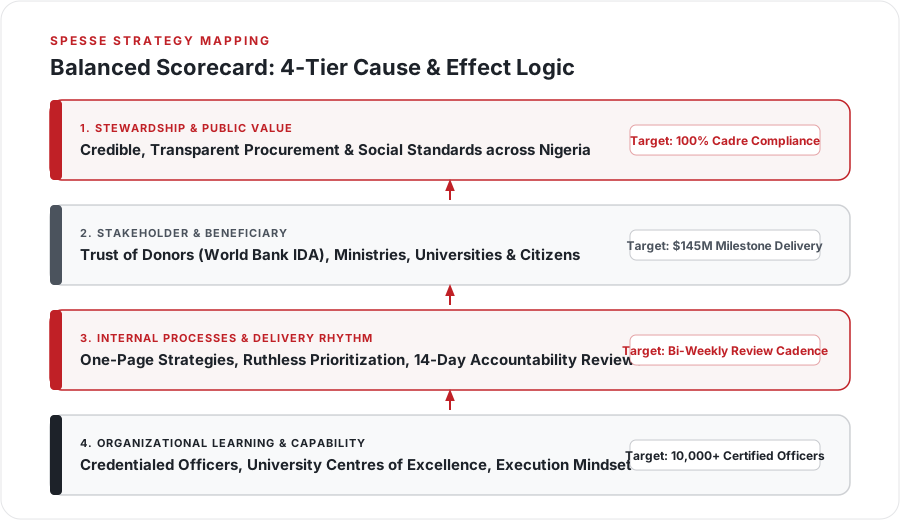
SPESSE 4-Perspective Balanced Scorecard Flow
Cause-and-effect logic connecting staff learning and internal process discipline to national standards compliance.
CORE INSIGHT

The Distinction: Systems Over Skills Transfer

This is the distinction that matters for organizations thinking about executive capacity building. Skills transfer is necessary but insufficient.
What changes institutional performance is the installation of systems: measurement systems, accountability systems, and review frameworks that prevent organisations from drifting away from their own priorities.

The 14-Day Execution Contract

Participants left the workshop with an Execution Contract – a personal, specific commitment to action within 14 days, shared with an accountability partner from within the cohort. Progress is formally tracked and reported.
“When you said that we were getting workbooks, I thought it was going to be good material to be kept on the shelf. Instead, I found the quality of content to be extremely rich for us to use.”

Professor Tonie Okpeh
Project Participant · SPESSE
The expectation that high-quality content is for reference, and not for practical use, is one of the most persistent patterns in public sector training. Participants arrive conditioned to receive. ACE Analytix is intentional about delivering a well-designed execution workshop as opposed to generic capacity building.
But what exactly made this engagement different from another strategy or change management workshop? That is where the ACE Analytix approach becomes clearer.

What Made the Engagement Truly Different?

Read Part 3 to learn about contextual depth, output orientation, and systems thinking over skills transfer.

Let’s start the conversation

Tell us what you’re working on.

If you’re carrying a high-stakes priority where delivery is what matters, we should talk. We’ll tell you honestly whether we’re the right firm for it.